Your mortgage payment is three different things
One payment leaves your account, so most money apps record one expense. That single choice overstates what you spent, understates what you saved, and hides the debt you just paid down. Every month, quietly.
One payment, three destinations
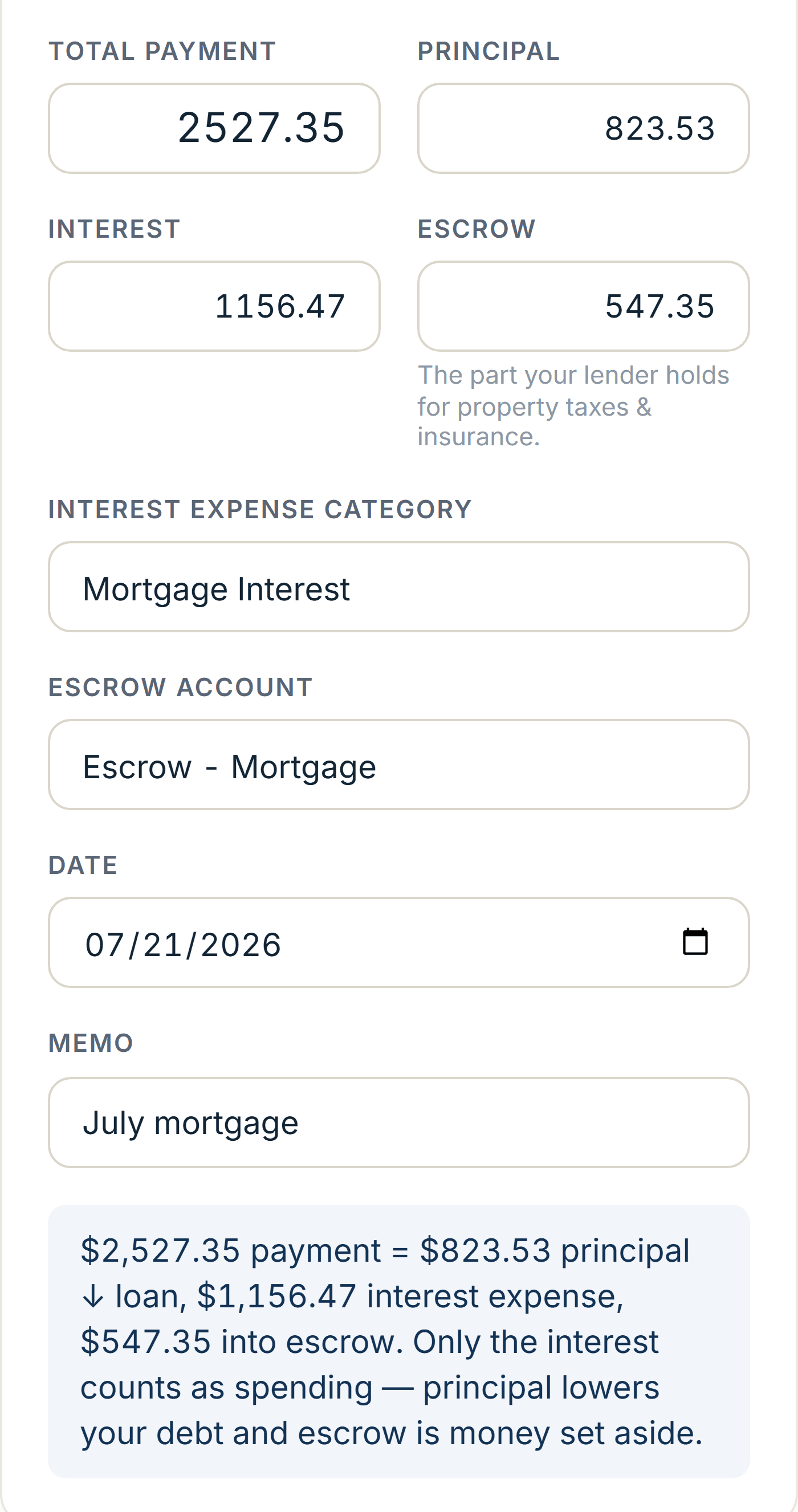
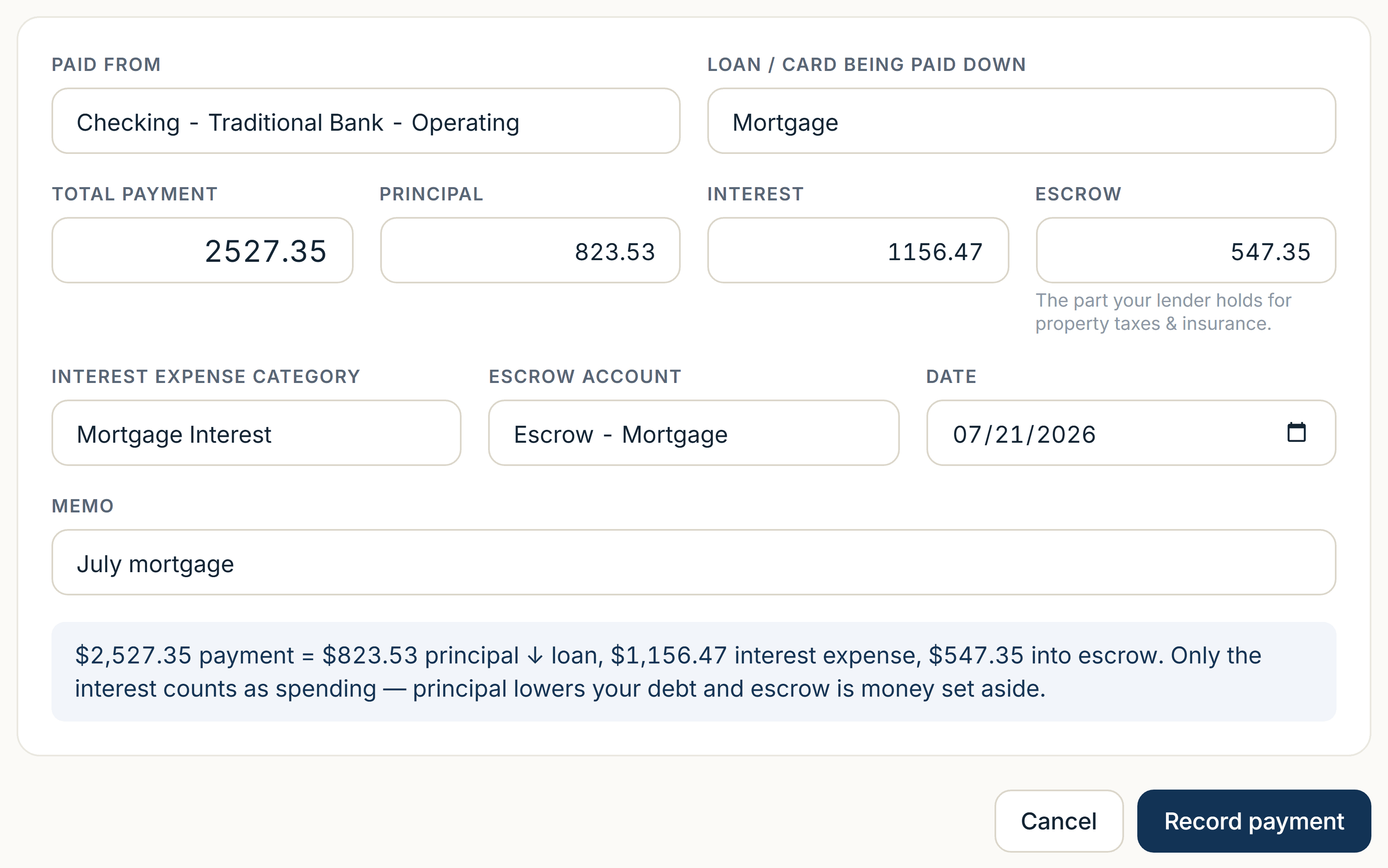
Take a real payment: $2,527.35 leaves checking on the first of the month. Your lender splits it three ways before any of it lands anywhere.
$823.53 is principal. It pays down what you owe. The money left your checking account, but it didn’t leave you. It moved from one side of your balance sheet to the other, and you owe $823.53 less than you did yesterday.
$1,156.47 is interest. This is what borrowing the money cost you this month, and it is gone. This is the part that is genuinely spending.
$547.35 is escrow. Your lender holds it to pay your property taxes and insurance when those bills arrive. It is still your money, sitting in someone else’s account with your name on it.
So of $2,527.35, the amount you actually spent is $1,156.47. The rest either reduced a debt or moved into a holding account.
What it costs to call the whole thing “Mortgage”
An app that sees one transaction and asks for one category has no way to tell those three apart. It records $2,527.35 of spending, and three things go wrong at once.
Your spending is overstated. In this example that is $1,370.88 a month, a little over $16,000 across a year, recorded as money you spent when it wasn’t.
Your savings rate is understated by the same amount, because paying down a loan is saving. It just doesn’t look like it when it’s filed under housing costs.
And your net worth never moves for it. You paid off $823.53 of debt and nothing reflects that you are better off than you were. The one number that should have gone up is the one that stays still.
What it looks like recorded properly
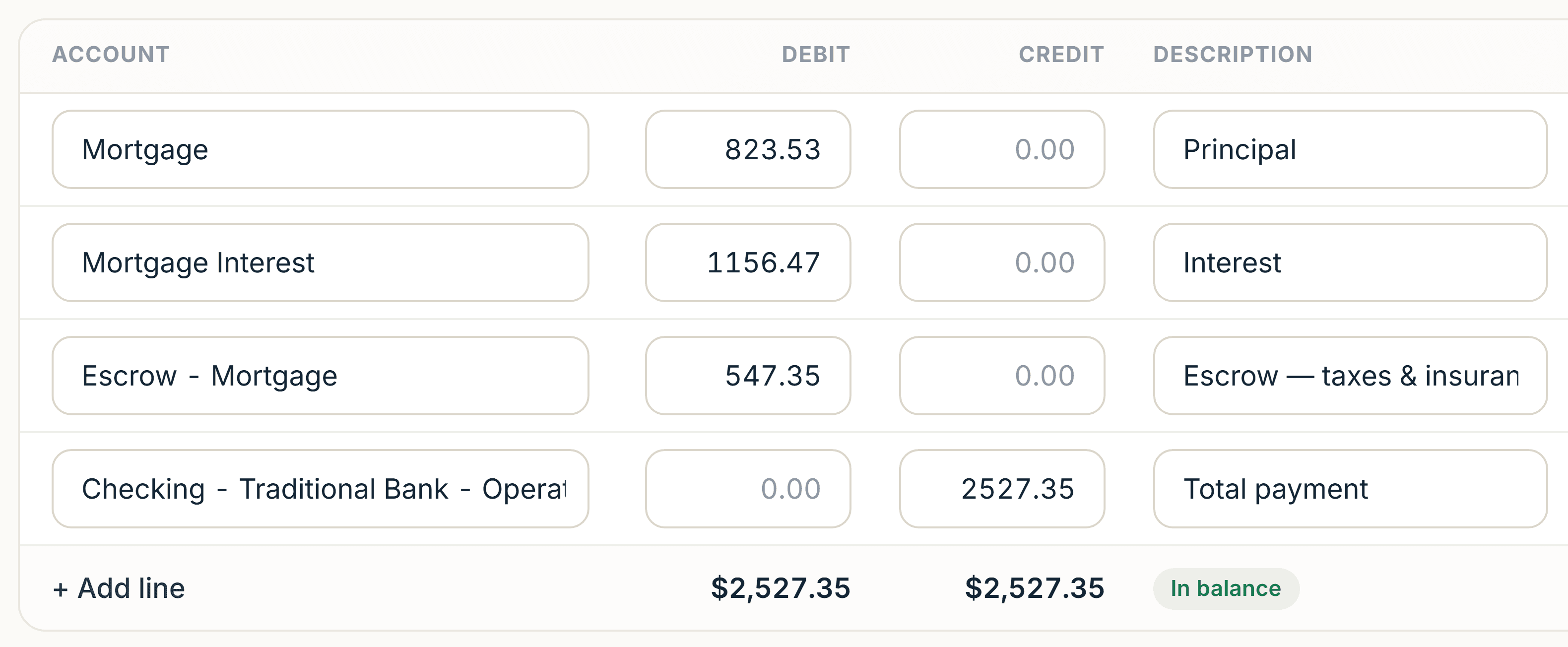
Split into its parts, the same payment produces four lines instead of one. The loan balance goes down by the principal. An expense account takes the interest. The escrow account takes the rest. That one is an asset, because the money is still yours. Checking gives up the total, and the four lines balance.
Read across it and the month makes sense: $1,156.47 of housing cost, $823.53 less debt, and $547.35 set aside for a bill you already know is coming.
How to find your own three numbers
They are on your mortgage statement, and you don’t need an amortization calculator to get them. The statement shows the principal and interest for the payment and lists the escrow portion separately, often as “escrow” or “taxes and insurance”.
The split changes every month, which is the whole point of an amortization schedule. Early in a loan most of the payment is interest, and the principal share grows with each payment. A few years from now the same $2,527.35 will be doing noticeably more for you than it does today.
If your escrow amount changed recently, your lender ran its annual escrow analysis: taxes or insurance moved, and the monthly set-aside was adjusted to match.
Three cases worth knowing about
Extra principal payments. Money sent above the scheduled payment goes entirely against principal. None of it is spending, and it is the one payment where the whole amount stays with you.
Escrow shortages and refunds. After the annual analysis, a shortage is usually spread across the next year’s payments and a surplus comes back to you. That refund isn’t income. It is your own set-aside money coming home.
Mortgage insurance. If your payment includes PMI or MIP, that part behaves like the interest rather than the escrow: it is a cost, and you don’t get it back.
And this article is not tax advice. How any of it is treated on a return is a separate question, and the person to ask is one who can see your whole picture.
Marked Money splits a loan payment for you and keeps the three parts straight afterwards, so paying down a debt stops looking like spending it.
Start your first ten minutes — free betaNo bank linking. Export your data anytime.